
The constant development of sophisticated vacuum pumps and vacuum technology opens the door to new possibilities, and vacuum pumps and systems are used everywhere from scientific research to semiconductor production.
Below are just some of the interesting applications of vacuum technology:
01Research and development
Research and development projects are a very important “customer” of vacuum technology. Particle physics research is carried out in particle accelerators, which use enormous electromagnetic fields to accelerate protons to near the speed of light and then track their collisions with other particles. This would not be possible without ultra-high vacuum. The result is so-called “exotic matter” released when protons collide with other particles, and studying it and these extremely short collisions reveals the building blocks of subatomic particles that govern almost everything in the Universe.

02Space research
Vacuum technology is an integral part of space research, in the form of ultra-high vacuum.
Ultra-high vacuum is used to isolate the mirrors inside an interferometer from noise, creating an environment without sound and therefore without vibration. This technology is used in research into gravitational waves and black holes.


03Analytical instruments
One of the most common uses of vacuum pumps is mass spectrometry in laboratories. The pumps used here are high-tech vacuum technology in terms of automation, control, compactness, resolution, efficiency, quiet operation and low maintenance costs. Mass spectrometry allows almost instant identification and measurement of thousands of types of molecules, as well as a detailed picture of how they react to drugs – without expensive reagents.


04Energy efficiency in construction – vacuum glazing
Vacuum-insulated glass is a growing technology in energy-efficient building, developed to meet several thermal performance requirements in the production of “net-zero” energy windows. Triple vacuum-insulated windows reduce heat flow between the warm and cold side of the window and provide high thermal protection – as much as 88.2% higher than windows with triple air filling.

05Hyperloop
Since the invention of the wheel, humanity’s drive for better transport has never slowed – it has only grown. Thanks to recent advances in technology and science, scientists and engineers have joined forces to reinvent transport, and that brings us to Hyperloop.
Hyperloop uses vacuum in sealed tubes through which passenger capsules travel. The vacuum reduces air resistance and, combined with low-friction propulsion and levitation technology in a closed system, allows capsules to travel at up to 1,200 km/h. A 560 km route could be covered in just 35 minutes – much faster than conventional trains and far better for the environment than air travel.


06Vacuum in food processing
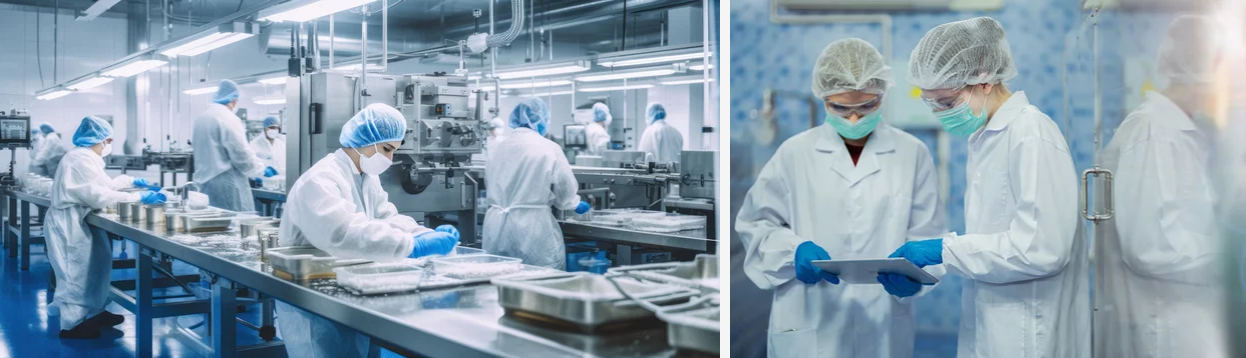
Fresh food products spoil quickly unless there is a way to preserve them. There are two different vacuum processes. One is microwave vacuum drying, in which products are heated to between 35 °C and 60 °C while a vacuum pump keeps the vacuum at 10 mbar. In this environment the water content evaporates.
In freeze-drying, products are cooled to between -20 °C and -40 °C and the water sublimates from the solid phase at a pressure between 0.1 and 1 mbar. This process is also used for freeze-drying coffee and pharmaceutical products. Vacuum processing significantly extends the products’ shelf life.


07Vacuum technology in medicine
Magnetic resonance imaging (MRI) is used to examine soft tissue such as organs, ligaments, the cardiovascular system and the spinal cord. MRI scanners consist of superconducting magnets cooled with cryogenic liquid (almost to absolute zero). Once the magnet becomes superconducting, current can flow through the coils indefinitely, without resistance and without an external power supply. The magnet sits in a cryostat – a vessel inside another vessel – and the vacuum between the outer and inner vessel plays a key role in stopping heat from reaching the cryogenic liquid.


08Vacuum coating
Vacuum coating deposits layers of material atom by atom or molecule by molecule onto solid surfaces inside a vacuum. The layers can range from one atom to several millimetres thick, and several different materials can be deposited, as in optical coating. Many medical implants placed in the human body (pacemakers, stents, epidural probes and others) are coated this way with a special film that protects the body from metal or plastic leaching, and protects the implant from body fluids.