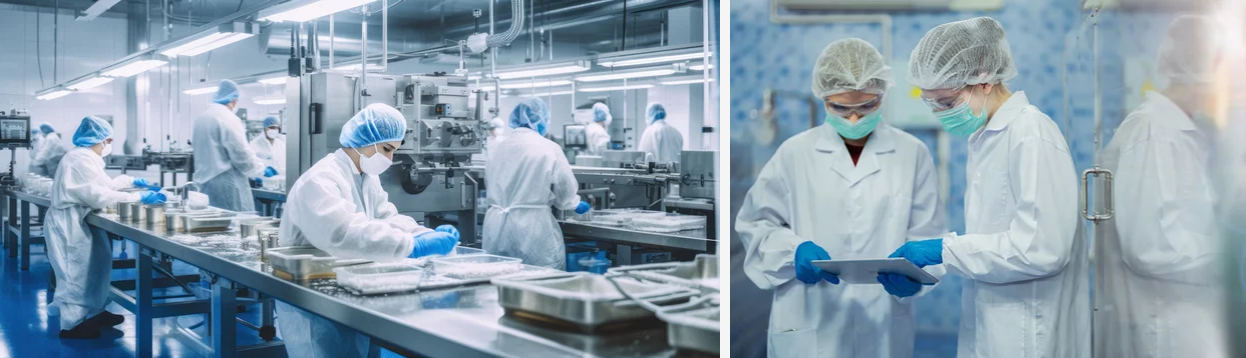
In modern meat processing plants, where hygiene, productivity and energy efficiency are the key factors, vacuum technologies play a central role. From vacuum packaging, product transport and controlled atmosphere to drying and cooling – all of this requires a stable, reliable vacuum without compromising hygiene standards. This is exactly where the Leybold DRYVAC series takes an important place.

01Dry – oil-free technology for maximum hygiene
DRYVAC pumps use fully dry (dry screw) technology, which means there is no oil in the compression chamber. This is a big advantage in the food industry – there is no risk of oil traces reaching the line or the product, and no problems with oily condensate or undesirable levels of contamination.
DRYVAC models are also designed to operate under high loads of moisture and steam – a common challenge in meat plants (e.g. washing, steam from meat, condensation).

02Key advantages for the meat processing industry
- Hygienic cleanliness: no oil in the system, lower risk of contamination.
- Resistance to moisture and steam: DRYVAC models have capacities adapted to high water loads.
- High energy efficiency: thanks to the screw design and components such as integrated variable speed drives and tailored purge systems, energy is saved and operating costs are reduced.
- Reliability and continuous operation: for production lines that must run 24/7 without interruption, DRYVAC has proven to be a stable foundation.
- Flexible installation: the compact design allows installation close to production equipment, with fewer pipes and shorter vacuum lines, which reduces losses.


03Application examples
1) Rovagnati S.p.A. – Italy, producer of cured meat products

One specific case where the DRYVAC series was applied is Rovagnati, where dry vacuum pump technology was used in the lines for marinating, mixing and final packaging of cured meat products. In this case it was emphasised that dry technology helped avoid the risk of oil contamination and ensured uninterrupted packaging operation.
Advantage: stable vacuum, hygiene, less maintenance.
2) G. Mondini S.p.A. – Italy, meat packaging lines

In a collaboration between Leybold and Mondini, DRYVAC technology was used in the transition from traditional packaging to skin packaging and MAP (modified atmosphere packaging). Using dry screw vacuum pumps allowed better control of the atmosphere and less downtime in production.
Advantage: better packaging quality, flexibility, lower maintenance costs.
3) Fast implementation in the meat industry with high water loads
According to the technical documentation, the DRYVAC DV 650 model series is optimised for applications with a higher water vapour content (up to ~25 kg/h) and offers “Hygienic design” options (stainless steel protection, wash-down capability) – an excellent choice for plants where lines are washed frequently and there is a risk of corrosion or condensation.

04Integration in meat processing plants: practical tips
- When designing the vacuum station, place the DRYVAC as close to the line as possible to minimise the length of the piping and reduce losses.
- Include a purge and separation system (purge gas, gas ballast) so the pump can tolerate variable loads – meat, steam, condensate.
- Consider the “Hygienic version” of the model (stainless steel protection, protective covers, wash-down capability) when the pump is located in the production area or is washed regularly.
- Plan for service access – although maintenance intervals are longer than with traditional pumps, regular inspection, cleaning and monitoring of parameters (temperature, vibration, vacuum level) are key to long service life.
- Choose variable speed control so the pump can adapt its operation to the actual vacuum demand – this contributes to energy efficiency and lower operating costs.
05Why choose Tehnogama as your partner
As the exclusive representative of Leybold vacuum solutions for Serbia, Montenegro and Bosnia and Herzegovina, Tehnogama covers every stage: from choosing the right pump, through installation and commissioning, to maintenance and service support. This means the customer gets a system optimised for their specific requirements, as well as support in adapting the process.
06Conclusion
In the meat processing industry, where hygiene, continuity of operation and efficiency are key, vacuum technology is no longer “just auxiliary” – it is the foundation of the production process.