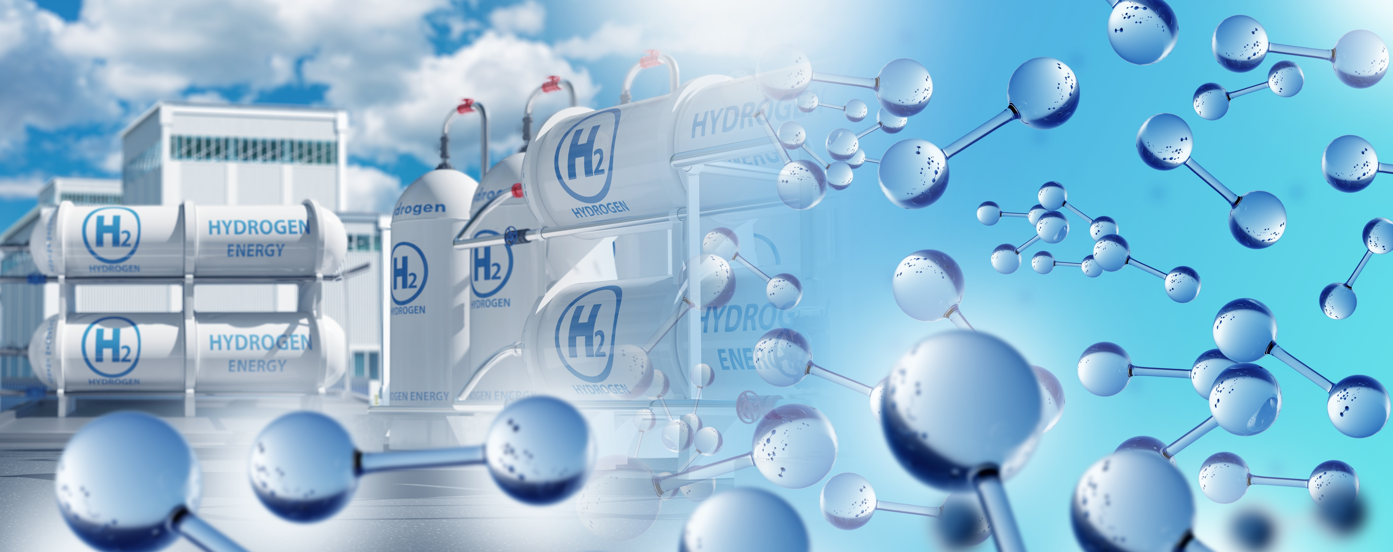

Hydrogen (H2; dihydrogen) was discovered in 1766 by the British physicist Cavendish. It is the most common element in the universe (the main element of the Sun and stars). On Earth hydrogen is rarely found on its own; it is very often part of various organic compounds and – most importantly – part of water.
Hydrogen is an extremely flammable gas (with oxygen) and becomes very dangerous when its concentration in the environment increases.
Under normal temperature and pressure, hydrogen is a colourless, odourless gas, lighter than air. It is soluble in water up to 1.6 mg/l at 21 °C.
Depending on temperature and pressure, it can exist in different states: gaseous, liquid, solid, metallic and triatomic. This article is about hydrogen in its gaseous state.

01Traditional uses of hydrogen
Hydrogen is known for the use of its atom in fusion, and has historically been used in the following applications:
- Chemical industry – production of ammonia and artificial fertilisers
- Petrochemical industry – sulphur removal; producing petrol and diesel by hydrocracking; methanol production (synthesis of amines and alkanes by hydrogenation)
- Food industry – producing margarine and butter by hydrogenating fats
- Welding – atomic hydrogen (plasma) welding
- Glass production – as an antioxidant or shielding gas combined with nitrogen
- Electronics – production of semiconductors, LEDs, displays, etc.
- Space research – rocket engineering (liquid form)

Thanks to the constant development of hydrogen production by steam reforming (“grey” and “blue” hydrogen) and especially by electrolysis (“green” hydrogen), hydrogen is increasingly seen as the vector that will enable the much-needed change in global patterns of energy production and consumption. Hydrogen offers an alternative solution to the problem of storing electricity, which has long held back the development of cleaner, CO2-neutral technologies.
02New ways of producing and using hydrogen
- Power generation – producing green hydrogen by electrolysis in “Power-to-Gas-to-Power” (P2G2P) plants, using electricity from renewable sources such as wind turbines and photovoltaic panels.
- Green mobility, to reduce the CO2 footprint – fuel cells.
Fuel cells are devices that convert hydrogen into electricity. They are similar to batteries in that they generate electricity through an electrochemical process, but unlike batteries they do not run out of energy and can keep producing electricity as long as they are supplied with fuel and oxygen. Fuel cells are highly efficient and produce electricity with little or no CO2 emissions, which makes them a promising technology for clean energy. One of the best-known applications is transport: fuel cell vehicles (FCVs) are powered by hydrogen fuel cells that generate electricity for the vehicle’s electric motor.

03H2 dryers – dryers for compressed hydrogen
Before use, gaseous hydrogen must be cleaned and prepared for safe use.
Hydrogen dryers (H2 dryers) are designed for the continuous removal of water vapour from compressed hydrogen, lowering its pressure dew point.

Hydrogen is a highly flammable gas that must be handled with care, and hydrogen dryers are made to order to meet all the specific requirements of a project. Provided the level of oxygen (or any other reactive component) in the gas mixture is reduced to a minimum, several dryer versions are available depending on working pressure, temperature and required dew point.
Regeneration is thermal, and the components of each hydrogen dryer are adapted to the availability and type of fluids for regeneration/cooling, to keep gas loss to a strict minimum (max. 1–2%, for example when dry gas from the surroundings is available for regeneration/cooling).
- H2-R-DRY – heat-regenerated adsorption hydrogen dryer, working pressure 5–11 bar
- H2-HP-R-DRY – heat-regenerated adsorption hydrogen dryer, working pressure up to 50 bar