
In the industrial landscape, the efficiency of the compressor system plays a key role in productivity and cost management.
Leaks in the compressed air network have a significant impact on both financial performance and workplace safety.
Below we look at the dangers of leaks in the compressed air network, walk you through concrete strategies for identifying and minimising losses, and show them through the lens of finance.
01Identifying leaks in the network
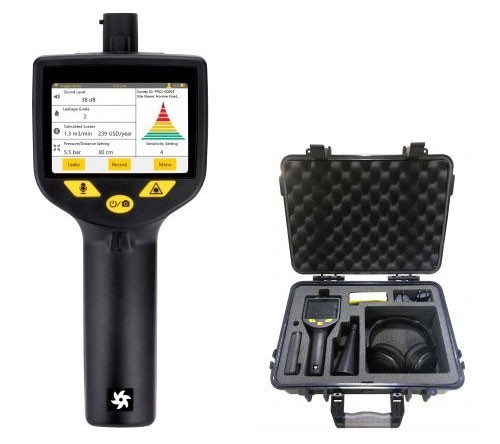
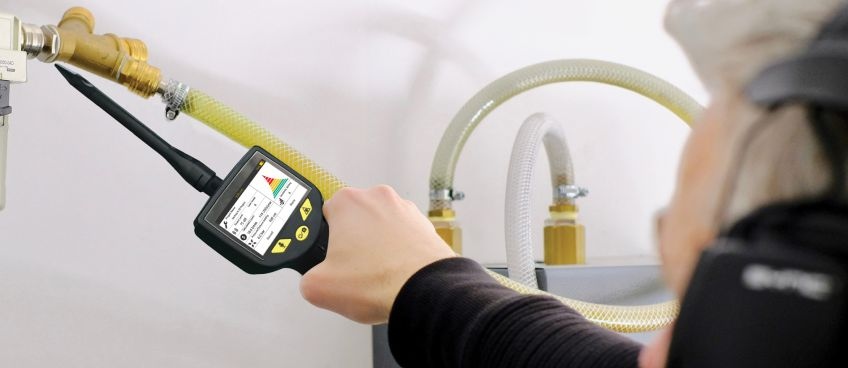
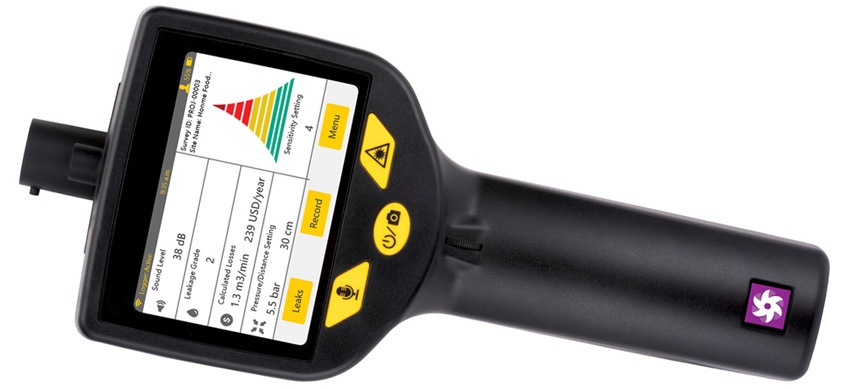
Detecting leaks in the compressed air network is key to minimising their impact on the bottom line. The most common signs are hissing sounds, pressure drop and what you see when inspecting connection points. Advanced tools such as an ultrasonic leak detector and a thermal imaging camera make leak detection on the distribution network far more precise and efficient.
Anyone who has been in a production hall after working hours has heard the occasional sound of air leaking from the compressed air installation. These leaks can cause significant costs. Losses from leaks can reach up to 25% of total compressed air consumption and can occur in many places: valve seals, welds, corroded pipes, rubber hoses, couplings, faulty automatic condensate drains, filter regulators, malfunctioning safety valves, pneumatic cylinders…
A leak behaves like a nozzle from which air escapes at high speed – 24 hours a day, 365 days a year. The result is lower network pressure and a compressor that switches on more often even when consumers are idle, wasting valuable energy the whole time and reducing the efficiency of the entire system.
Leaks in the compressed air network can cause thousands of euros in losses. Leak detection is an important maintenance task that can traditionally be done with soapy water, but much more accurately with an ultrasonic leak detector – especially because some leaks cannot actually be heard. An ultrasonic detector can pick up such “micro” leaks even from several metres away.
02Reducing leaks in the network
Correcting existing leaks and preventing new ones requires a proactive approach. Regular equipment maintenance, staff training and quality components are crucial to minimising the chance of leaks.
03The cost of compressed air leaks
To fully understand the cost of leaks in the compressed air distribution network, once leaks have been detected with an ultrasonic detector, the amount of air lost over time is calculated.
When consumers are not running, you can measure the amount of leakage by tracking the compressor’s automatic starts and stops. Since the system is not depressurised, its pressure falls and the compressor switches on to reach the set pressure and refill the whole system.
Example
- Vp – leakage in m³/h
- Vk – compressor capacity in m³/h
- t – total compressor running time during the measurement (t1 + t2 + t3 + t4 + …)
- T – total measurement time
Vk = 5.3 m³/h · t = t1 + t2 + t3 + t4 + t5 = 150 s · T = 900 s
Vp = (Vk × t) / T = (5.3 × 150) / 900 = 0.883 m³/h – a 16.6% loss of air from leaks alone!
For a 37 kW compressor, covering these leak losses takes 37 × 0.166 = 6.1 kW of electricity every hour.
When the compressor is connected to the network all the time, these leaks run 24 hours a day, 365 days a year, which adds up to 6.1 kW × 24 h × 365 days = 53,436 kWh of electricity a year.
Multiplying this energy by a price of €0.12 per kWh gives a cost of as much as €5,212.32 caused by leaks in the network.

Efficient compressor systems are vital parts of industrial operations, and reducing leaks is a key aspect of achieving efficiency. By understanding the risks, using effective leak detection methods and addressing leaks proactively, you will unlock your plant’s full financial potential and a safe working environment.