
The ambient temperature around the compressor has a major impact on the compressor’s performance.
Every air compressor – piston, screw, rotary or other – produces a certain amount of water while compressing the ambient air it draws in. This water is not a result of the compression technology, but of the physical properties of the intake air and its transformation.
At a given temperature, 1 m³ of air can “carry” a certain amount of water. The air we breathe, and that the compressor draws in, contains a percentage of moisture (water) in gaseous form. The example below shows exactly how much water 1 m³ of air carries at a given temperature, and how compression to 8 bar generates water:

Water combined with solid particles that are also part of ambient air, and with the oil that lubricates vital compressor components, is harmful to the tools and machines driven by compressed air and affects the quality of the products themselves. It is therefore essential to remove all these contaminants from the system. This article is about water – eliminating it from the compressed air system.
01How water is removed
Many screw compressors come with cyclone condensate separators as standard. Compressed air leaving the compressor is warmer than the surrounding air. This warm air cools as it travels through the distribution piping to the machines, and the moisture that was vapour before cooling condenses.
While moisture is in gaseous form, we cannot “catch” it and therefore cannot remove it from the system. Once it has turned into liquid, however, it can be caught and removed. Cyclone separators, timer-controlled drains, intelligent drains and other condensate drains do exactly that – catch the water and physically remove it from the system.
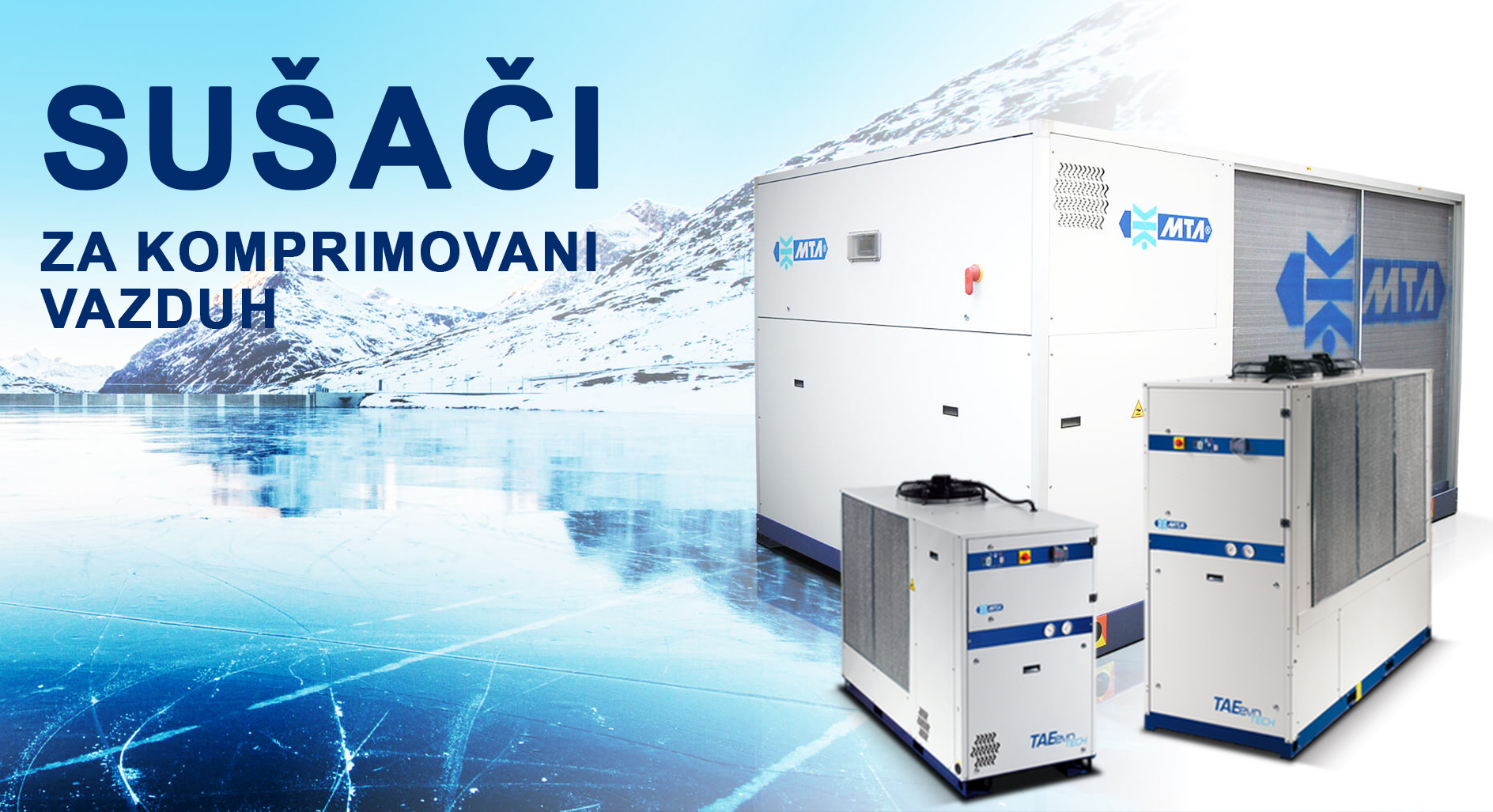
To cause condensation faster and more effectively, refrigeration dryers are used. As the name suggests, they cool the compressed air using refrigerant and make the moisture condense. The dried air continues to the machines, and the collected condensate is removed from the system by a condensate drain.
02The limit of refrigeration dryers
Refrigeration dryers have a limit: they cool to a dew point of 3–5 °C, the temperature below which the remaining moisture will condense.
If, after the refrigeration dryer, the air flows on to the machines through piping that cools – in winter, for example – below 3–5 °C, the moisture remaining in the compressed air after the dryer will condense (according to the moisture table, that is 5.9–6.8 g of water per m³ of air).
In such cases, and in applications such as cold stores, desiccant (adsorption) dryers are used. They do not work by cooling the air; instead, they use the physical properties of desiccants, which adsorb moisture that is still in vapour form.
The most commonly used desiccants are molecular sieves, activated alumina and silica gel. Air that has passed through an adsorption dryer has residual moisture as if dried at -40 °C – just 0.11 g of water per m³ of air.
03Still seeing water despite a dryer? Check this
- Check that the bypass valve around the dryer is closed
- Check that all condensate drains installed in the system are working
- If you use an adsorption dryer, make sure air is passing through the silencers – that they are not clogged
- Make sure there are no large temperature differences between the compressor air inlet and outlet
- Check that your dryer is correctly sized for the compressor capacity and temperature differences
- Contact us for details on reference ambient and operating conditions and any other help in these situations
Hot summer months are on the way – check your compressed air system in good time and be ready for summer!
Table: water content of air in relation to air temperature